
Read
When DeepSeek broke into global view in January 2025, I was less interested in where it ranked on a benchmark than in what happened on Wall Street.
In a single day, NVIDIA lost roughly $593 billion in market value. Markets can overreact, of course. But a move that violent rarely happens for no reason. DeepSeek touched a nerve beneath the entire AI investment thesis:
Does advancing intelligence truly require ever more expensive silicon, ever larger compute clusters, and exponentially greater capital expenditure?
A year and a half later, the question returned.
When Moonshot AI released Kimi K3 in July 2026, it reignited an anxiety markets were already wrestling with: whether today’s valuations—and the staggering infrastructure spending behind them—could be sustained if frontier-level capabilities continued to emerge from radically different cost structures.
DeepSeek could still be dismissed as an anomaly. When similar efficiency breakthroughs keep appearing, that explanation becomes harder to sustain.
And that points to the question we should be asking:
Have we been watching the wrong variable?
For three years, collective attention has fixated on capability frontiers—what models can do next in writing, coding, reasoning, and tool use.
But a quieter variable may matter far more for corporate margins, capital allocation, and market prices:
The cost of acquiring intelligence is collapsing.
Capital markets do not price benchmark victories. They price future cash flows.
And beneath every valuation sits a fundamental question:
What scarcity will tomorrow’s profits be built on?
If intelligence transforms from a scarce capability into an on-demand commodity—metered per token, per API call, per task—then many prices we take for granted must be recalculated: the price of human labor, enterprise cost structures, the value of energy, and ultimately the pricing of capital assets.
That is the starting point for tracking our first Critical Variable: the cost of intelligence.
Once that cost crosses a decisive threshold, AI stops being merely a technology story.
It becomes an economic one.
When Intelligence Gets Cheaper, What Human Capabilities Retain Value?
Enterprises have always made decisions based on cost: which tasks deserve human labor, and which belong to automated systems.
When machines could only execute narrow scripts, they were assistants. Once they can understand intent, retrieve context, maintain dialogue, orchestrate tools, and deliver services at dramatically lower marginal cost, the economic calculus changes.
The Klarna case is telling.
In 2024, its AI assistant handled 2.3 million customer-service conversations in its first month—work equivalent to roughly 700 full-time agents. By 2025, Klarna reported that customer-service cost per transaction had fallen approximately 40% from early 2023 levels.
The more instructive development came later. Klarna began re-emphasizing human service after confronting a basic reality:
Cost can be compressed much faster than judgment, trust, and service quality.
The real story was never “700 workers replaced by AI.”
It was the internal unbundling of knowledge work.
Order lookups, policy explanations, routine routing, and standardized responses are commoditizing rapidly. Edge-case exceptions, relationship management, negotiation, discretionary judgment, and accountability are not becoming cheap at the same rate.
AI is not repricing human beings. It is repricing the specific capabilities that constitute a job.
Machines absorb the tasks that are easiest to standardize.
The human wage premium migrates toward what resists commoditization: judgment, trust, synthesis, negotiation, and the willingness to own outcomes.
Once that repricing spreads across enough roles, it does not stop with wages.
It alters a company’s entire cost structure.
Companies Have Not Stopped Spending. The Money Has Moved.
If AI reduces the cost of knowledge work, shouldn’t companies end up spending less?
Alibaba offers a clear counterexample.
In 2025, the company announced plans to invest at least RMB 380 billion over three years in AI and cloud infrastructure.
The takeaway is not simply that tech giants are spending aggressively on AI. It is the underlying transmission mechanism:
Falling intelligence costs do not eliminate expenditure. They redirect capital toward new bottlenecks.
Historically, corporate spending on “intelligence” flowed into payroll, software licenses, and outsourcing contracts.
Today, that capital is increasingly flowing into silicon, compute clusters, inference capacity, servers, and high-density data centers.
Why does aggregate spending rise while the unit cost of intelligence falls?
Because cheaper intelligence changes the question:
How can we do the same work for less?
becomes:
If intelligence is now this cheap, where else can we deploy it?
That leads to one of the most important economic dynamics in this entire transmission chain.
The Jevons-Style Rebound
In the nineteenth century, economist William Stanley Jevons observed something counterintuitive.
As steam engines became more fuel-efficient, Britain did not simply consume less coal. Lower operating costs made steam power economically viable across more industries, and total coal consumption expanded.
This dynamic became known as the Jevons Paradox.
The underlying insight is simple: when the unit cost of using a resource falls sharply, the increase in demand can overwhelm the savings created by greater efficiency.
AI is beginning to show the same pattern.
Cheaper models do not make enterprises consume less intelligence. They make it economically rational to embed intelligence inside more software, more workflows, and more automated decisions.
Cheaper Intelligence → Wider Utilization → Rising Demand for Compute & Energy
And once that happens, scarcity begins to migrate.
The Physical Migration of Scarcity
When Microsoft signed a 20-year power purchase agreement tied to the planned restart of Three Mile Island Unit 1, the transmission chain became tangible.
A nuclear unit that had shut down for economic reasons suddenly had a new commercial rationale—driven in part by the long-term electricity demands of data centers.
A revolution taking place in software had reached all the way into the economics of nuclear power.
That is the part worth paying attention to.
Scarcity is migrating from the digital world to the physical world.
As cognitive generation becomes abundant, hard economic bottlenecks concentrate in physical constraints:
Baseload power generation and grid interconnect capacity
High-density data-center infrastructure
Advanced silicon, packaging, and specialized compute
High-integrity proprietary data that cannot simply be synthesized on demand
Technology creates new capabilities. Markets reprice new scarcities.
The more intelligence becomes a commodity, the more important another question becomes:
What does all this intelligence depend on that cannot be scaled nearly as easily?
The Final Repricing Is Ourselves
At the end of this transmission chain sits the individual professional.
Consider junior analysts on Wall Street.
For decades, the apprenticeship model involved building financial models, compiling data, preparing pitchbooks, and revising presentations. Large language models can now accelerate substantial parts of those workflows.
Yet complex transactions still demand client judgment, risk assessment, negotiation, customization, and accountability.
The job does not simply disappear.
Its cognitive baseline shifts upward.
Recent labor-market data shows that entry-level roles heavily exposed to AI are increasingly requiring capabilities traditionally associated with senior professionals: strategic judgment, high-context communication, cross-domain synthesis, and decision-making under uncertainty.
The traditional career curve—
spend years executing routine tasks before earning the right to exercise judgment—
is being compressed.
AI is not merely automating junior tasks. It is pulling senior-level expectations earlier into a career.
What machines can execute becomes cheaper.
What machines cannot assume on your behalf—framing the right problem, navigating ambiguity, integrating across domains, communicating under pressure, and owning the outcome—becomes distinctly scarce.
And that brings the argument back to money.
Three Accounts Worth Repricing
The Income Account
Which capabilities will continue to earn a wage premium?
As information retrieval, synthesis, and standardized execution become cheaper, the premium is likely to migrate toward abilities that resist standardization: defining the right problem, integrating across disciplines, negotiating under uncertainty, exercising judgment, and taking responsibility when no answer is obviously correct.
The Corporate Profit Account
Do not ask only whether a company “uses AI.”
Ask what AI actually changed in its economics.
Which marginal cost did it compress?
And more importantly: does the company have enough structural advantage to retain those productivity gains—or will competition rapidly pass them through to customers?
The real question is not whether AI creates efficiency.
It is who gets to keep the economic value created by that efficiency.
The Asset Account
If intelligence continues to commoditize, where might scarcity become more valuable?
The more useful question is whether incremental value is migrating toward hard physical constraints: baseload power, grid expansion, critical data-center locations, specialized compute infrastructure, and proprietary data that cannot easily be replicated.
Not every bottleneck becomes a good investment.
But every major repricing cycle begins by identifying what the system suddenly cannot produce fast enough.
The Critical Variable Transmission Chain
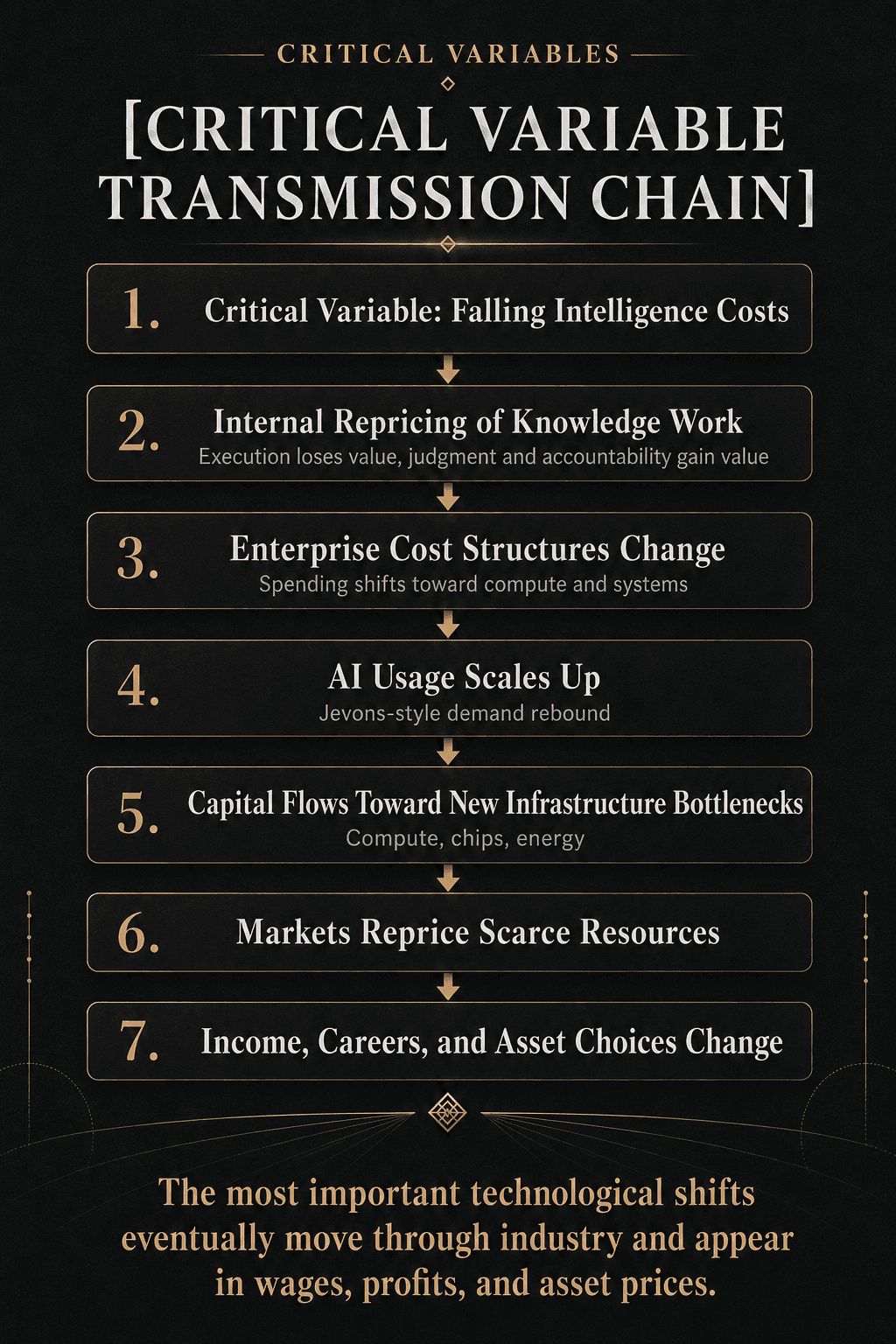
The most important technological shifts eventually move through industry and appear in wages, profits, and asset prices.
This essay is the first installment of Critical Variables—an ongoing series examining the technological, economic, industrial, and capital thresholds reshaping our world.