
Read
A few days ago, while following reports of the catastrophic flooding and debris flows along the Nepal–Tibet border, I found myself reopening Chapter 16 of RIFT: Gestalt. The connection was not that the real disaster had occurred in the same place as the one in my novel—it had not. The August 26 event began high in the Himalayas with a glacier collapse that released rock, ice, and debris into the river system, generating destructive flooding downstream and creating new secondary hazards as debris blocked waterways. What caught my attention was the physical structure of the event: a failure high in a mountain system did not remain a single failure. It propagated, changed form, mobilized other materials, and altered the conditions for everything downstream.
That mechanism felt familiar because it resembles one of the principles I kept returning to while constructing RIFT: disturbances in complex systems rarely stay where they begin. A change in one layer can propagate into another, and the secondary consequences may ultimately matter more than the original event. In the novel, that principle operates across consciousness, information networks, topology, and eventually the physical environment. In the real Himalayas, of course, the mechanisms are geological and hydrological. The resemblance is not a prediction. It is a reminder of why I began with real systems before allowing the fiction to move beyond them.
The Collision
RIFT: Gestalt is set in 2033. Chapter 16, Section IV opens with a location marker that felt unusually vivid when I returned to it this week:
China. Tibet. Dingri County. Mudslide disaster zone. 2:00 p.m.
Sangye woke to the smell of mud. Not the dry, wind-abraded, powdery loess smell of the plateau—the smell he’d grown up with…
As the scene continues, Sangye emerges from the tent and finds a landscape already reorganized by the disaster. A road outside Dingri has been cut into sections; asphalt has been lifted from its base; rescue vehicles, military trucks, and emergency personnel move through the mud. The scene is fictional, but I did not want the physical environment around it to feel fictional. The mud, the road damage, the altitude, the logistics of rescue, and the broader Himalayan setting all had to belong to the same Earth the reader already knows.
A friend who had read the Chinese edition remembered this passage immediately after seeing the news. Her first reaction was playful: what kind of prophet are you? Her second observation was more interesting. What she remembered about the book was how much real-world research sat underneath the science fiction, and how closely that research had been woven into the speculative elements.
That is a much better description of what happened. I have never thought of science fiction as a form of prophecy. What interests me is the point at which research reaches the edge of what is known, leaving enough uncertainty for disciplined extrapolation to begin.
Why Dingri? The Constraint of Real Geography
Dingri was not chosen because I needed an exotic Tibetan location, and I did not begin by deciding that Chapter 16 required a mudslide and then search for somewhere to place it. The causal sequence existed inside the story first. Earlier in the novel, Li Tao attempts to resist the Rift network from the Himalayan region. His intervention collides with another signal in a way neither side intends, providing the system with enough input to cross an activation threshold. Alto later describes what happened with a single word: the collision “catalyzed” the network’s full activation.
At that point, the consequences of the Rift cease to be confined to information and cognition. Around Namcha Barwa, the sky itself appears fractured. Snow and ice move upward in an impossible reverse avalanche, and geomagnetic disturbances interfere with communications across the region. Once I had allowed the fictional mechanism to affect matter at that scale, I had created a new obligation for myself as the author. If the Himalayan environment was being physically disturbed, its secondary consequences could not simply appear wherever the plot found convenient. They had to occur in a landscape capable of carrying them.
That sent me back to the real geography and geology of the region. Dingri lies within the southern Tibetan Plateau, an area produced by the continuing collision between the Indian and Eurasian plates but also marked by significant extensional deformation. Research published after the 2025 Dingri earthquake has documented normal faulting within the southern Tibetan rift system and described the plateau as a region in which crustal thickening, strike-slip deformation, and distributed extension coexist.
Those structures matter because tectonic fracturing can precondition slopes by creating discontinuities and weakened rock masses. But preconditioning is not triggering: real slope failure is a multivariable process. Rock structure, slope angle, weathering, groundwater, precipitation, ice, seismic disturbance, and local topography can interact in different combinations. Himalayan landslide research has long emphasized this difficulty precisely: geology matters enormously, but no single geological variable is sufficient to explain or predict slope failure.
What mattered to me as a novelist was therefore not whether I could manufacture a neat scientific explanation for one predetermined location, but whether the broader physical environment made the fictional consequence credible.
High-mountain disasters provide some of the clearest examples of why that distinction matters. The 2021 Chamoli disaster in the Indian Himalayas began with a massive rock-and-ice avalanche at high elevation and evolved into a long-runout chain involving debris avalanche, entrainment, and flooding over more than 17 kilometres. The initial failure changed as it moved through the landscape; water, sediment, topography, and momentum transformed one event into several.
The recent Nepal–Tibet disaster offers another example of this cascading behavior. A glacier collapse released enormous quantities of ice, rock, and debris; downstream flooding then reorganized the river system, while newly formed debris barriers created additional risks that complicated rescue operations days after the initial event. The specific trigger, location, and physical sequence are different from those in RIFT. What matters is the systems principle: a disturbance can alter the conditions under which subsequent disturbances occur.
That distinction is essential. Fiction supplied the causal requirement; real geography constrained where I could plausibly place its consequences. Dingri emerged from the intersection of those two demands.
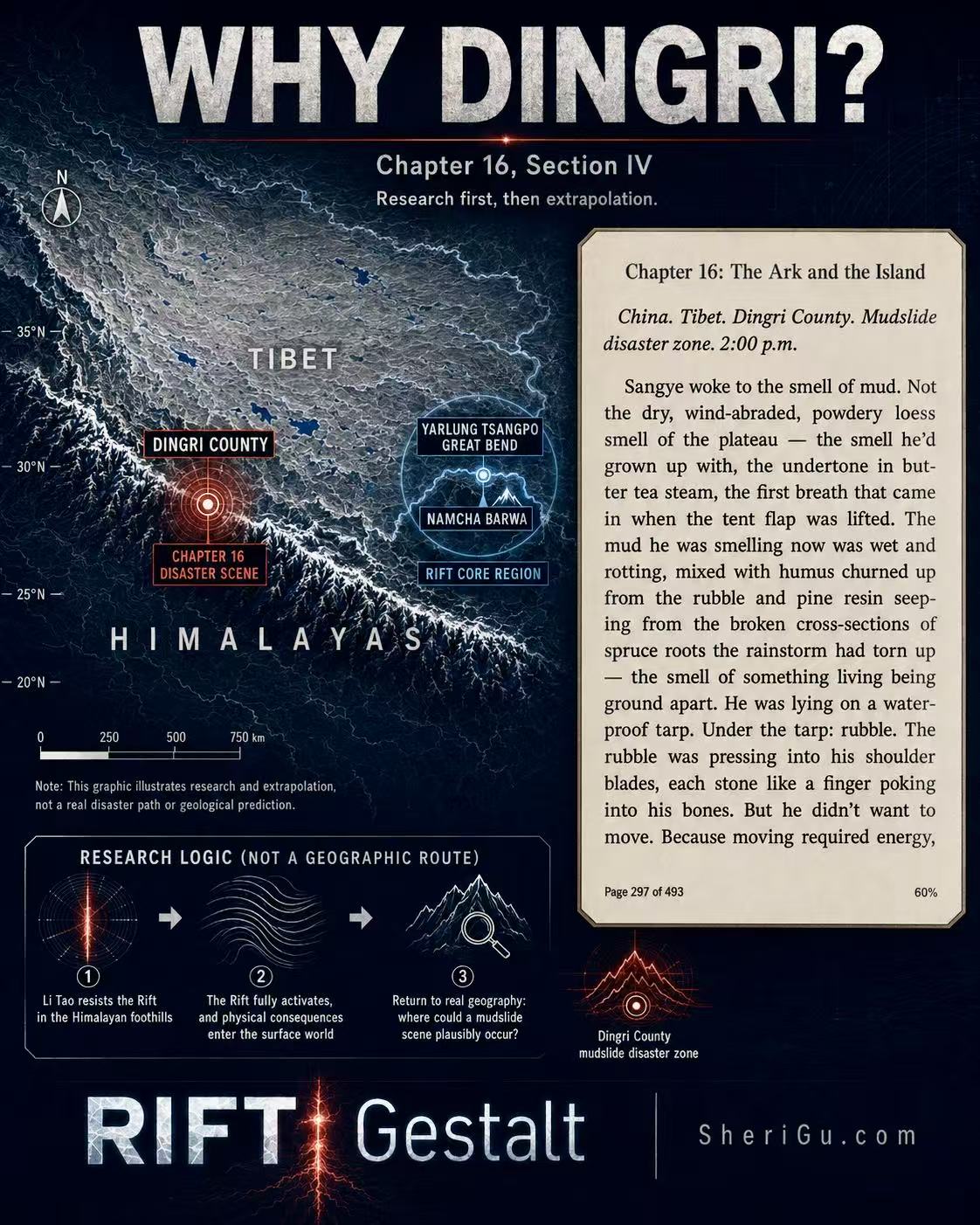
Figure 1. The internal causal logic behind the Dingri sequence and the real-geography constraint used in locating the scene. This is a worldbuilding model, not a real-world hazard map or geological prediction.
From Known Science to a Fictional World
The Dingri sequence is only one example of a rule I tried to apply throughout RIFT. I did not want scientific language to function as decoration added after the plot had already been designed. Instead, the research had to come early enough to constrain what the story was allowed to do.
My working process usually begins with established knowledge. I then look for the boundary: a phenomenon that science can describe but not yet fully explain, a theory whose implications remain contested, or a system whose behavior changes dramatically when one variable moves beyond its current range. Only after locating that boundary do I begin asking the speculative question. The sequence is therefore less “invent an extraordinary phenomenon and explain it scientifically” than “understand the existing system well enough to know where an extraordinary extension could begin.”
In its simplest form, the framework is: known science, unresolved question, plausible extrapolation, fictional world. The difficult word is plausible. It does not mean that scientists have demonstrated that the fictional mechanism can happen. It means that I try to preserve enough of the underlying constraints that the extrapolation does not casually contradict the system from which it grew.
This distinction becomes particularly important in a novel that touches fields where the scientific status of different ideas varies greatly.
Quantum effects in biological systems, for example, are real research subjects. Researchers have investigated possible functional roles for quantum coherence in photosynthetic light harvesting, avian magnetoreception, and other biological phenomena. But that body of work does not establish quantum coherence in the human brain as an explanation for consciousness. There is an enormous scientific gap between those statements, and RIFT deliberately crosses that gap as fiction rather than pretending that the gap does not exist.
That is where extrapolation begins. The speculative question is not “Is quantum consciousness already proven?” It is closer to: what changes if biological coherence can persist, couple, and transmit information on scales that current organisms do not appear to support? Once the fictional answer is introduced, the rest of the story has to accept its consequences.
Consciousness provides a different kind of opening because the scientific problem itself remains unresolved. Neuroscience still has no single accepted theory that explains how subjective experience arises from neural activity. Integrated information theory and global neuronal workspace theory, among others, make different predictions about the neural basis of conscious experience. A large adversarial collaboration published in Nature in 2025 directly tested predictions from IIT and GNWT and produced results that challenged important elements of both rather than delivering a simple winner.
For a novelist, this kind of uncertainty is more useful than an easy answer. It gives the story a genuine boundary of knowledge to work against. RIFT asks what might happen to memory, identity, and agency if consciousness is not as locally sealed as everyday experience leads us to assume. The unresolved scientific problem is real; the mechanism I build beyond it is fiction.
Topology gave me another kind of freedom, but also another kind of constraint. Ordinary geography tells us that London and Tibet are thousands of kilometres apart. Networks need not measure distance in the same way. Modern network science distinguishes shortest-path distance, latent geometry, and effective geometries generated by dynamical processes; two nodes can be remote in physical space while behaving as if they are much closer within another metric structure.
RIFT takes that idea far beyond established network science and physics by giving its network a higher-dimensional topology. But once that fictional rule exists, it cannot be invoked selectively. If London and Nyingchi can become topologically adjacent inside the Rift, every later consequence involving communication, propagation, and connectivity has to respect the same underlying logic. Speculation creates the rule; consistency makes the author live with it.
Geology works differently because the physical landscape gives the author far less freedom. River systems, mountain chains, altitude, erosion and tectonic structures exist before the story arrives. The Yarlung Tsangpo Great Bend, Namcha Barwa and the broader Himalayan system therefore became more than visual scenery in RIFT. They formed part of the architecture of the novel because their real geography gave me an unusual but physically grounded environment from which the speculative layer could grow.
The fifth foundation, collective intelligence, is less about a single scientific discipline than about the behavior of networks. Human groups, organizations, biological systems, and artificial systems all encounter versions of the same problem: how much coordination improves collective performance, and at what point the efficiency of information flow begins to suppress exploration, diversity, or independent search.
Research on social learning and network structure shows why there is no simple answer. Efficient, highly connected networks can outperform slower networks under some learning strategies, while less efficient networks can perform better under others because slower diffusion preserves exploration and prevents premature convergence on local optima. The trade-off depends not only on connectivity but on how individuals use information flowing through the network.
That tension eventually became one of the deepest questions in RIFT. If coordination becomes nearly perfect, what happens to individuality? If conflict, delay, duplication, and disagreement can all be treated as inefficiencies, which parts of human agency begin to look inefficient as well?
At that point, science becomes civilization, and worldbuilding becomes ethics.
Taken together, these domains produced the framework I use for the book: established science defines a boundary; an unresolved question creates an opening; extrapolation introduces a new condition; and the fictional world must then accept the consequences of that condition rather than resetting the rules whenever the plot becomes inconvenient.

Figure 2. The worldbuilding framework behind RIFT: known science → unresolved question → plausible extrapolation → fictional world, supported by five recurring domains: quantum coherence, consciousness, topology, geology, and collective intelligence.
Science as Narrative Constraint
The most useful question I found during the writing process was not, “How can I make this idea sound scientific?” It was, “What would have to be true for this idea to work, and what else would become true if it did?”
The first half forces the speculative mechanism to confront what is already known. The second half prevents the mechanism from remaining an isolated plot device. If minds can exchange information through a new channel, then privacy and identity change with it. If physical distance can be reorganized by another topology, geography no longer means quite what it used to mean. If collective intelligence can reduce coordination friction almost to zero, political and moral questions about autonomy become unavoidable. If the Rift can exert a physical influence on the environment, its effects cannot stop conveniently at the edge of a laboratory.
This is where worldbuilding becomes more than background design. A scientific premise begins to create institutions, incentives, vulnerabilities, and moral choices. The more powerful the premise, the more widely its consequences should propagate through the fictional system. For me, one of the tests of a hard-science-fiction idea is therefore not how technically impressive its explanation sounds, but whether the author is willing to live with everything that explanation implies.
This also explains why I distinguish between scientific accuracy and scientific discipline. A hard science fiction novel can speculate beyond what current science can establish; otherwise much of the genre would be impossible. The discipline lies in knowing where that departure occurs, being explicit with yourself about which assumption has been changed, and refusing to suspend the resulting consequences whenever they become narratively inconvenient.
That was how a topological anomaly first explored through consciousness and information eventually acquired geological consequences in the Himalayas. By the time Sangye wakes in Chapter 16 smelling wet mud, the mudslide is not an isolated disaster inserted to create atmosphere. It is several causal steps downstream from a choice made much earlier in the story.
The same principle applies elsewhere in the novel. If a brain can act as a node in a distributed network, biology has to bear the energetic and physiological cost. If information can propagate through a topology independent of ordinary three-dimensional distance, communications systems and geography have to respond. If thousands of individual minds can coordinate at increasing levels of coherence, social organization and political power cannot remain unchanged.
A premise becomes worldbuilding only when its consequences escape the scene in which the premise was introduced.
Beyond Prediction
The real Himalayan disaster did not make me think that RIFT had somehow predicted the future. Reality is far too specific, contingent, and complicated for that claim. The collapse involved a particular configuration of ice, rock, gravity, temperature, water, terrain, and timing, and its consequences have continued to evolve as debris altered waterways and created new downstream risks.
What it did remind me of was the discipline that drew me to hard science fiction in the first place. The genre does not need reality to prove the novelist right. Its more interesting challenge is to understand the present well enough that, when one variable is deliberately changed, the imagined future still retains the structural fingerprints of the world from which it grew.
That is the distinction I would make between prediction and extrapolation. Prediction asks what will happen. Extrapolation asks what might happen if a particular condition changes, while preserving as many other constraints as possible. The first is judged by whether the future comes true. The second can remain useful even when it never does, because it forces us to look more carefully at the systems we already inhabit.
For RIFT: Gestalt, that has always been the purpose of the science. Research establishes the limits of the known world; uncertainty provides the opening through which fiction can enter; and worldbuilding follows the consequences as far as they will go.
Sometimes that path ends in an argument about consciousness, collective intelligence, or free will. Sometimes it changes the geometry of distance itself. And sometimes it ends on a mountain road in 2033, with someone waking to the smell of mud.
————————————————
Selected References & Further Reading
The following sources represent several of the scientific boundaries that informed the research and worldbuilding discussed in this essay. They are not presented as evidence for the fictional mechanisms in RIFT: Gestalt, but as starting points—the established science and unresolved questions from which the extrapolation begins.
High-Mountain Cascading Hazards & Tectonics
He, K., Cai, J., Wen, Y. et al. — “Bipartite rupture in the 2025 Dingri earthquake indicates normal conjugate faulting during orogenic collapse.” Communications Earth & Environment (2026).
A recent open-access study of the 2025 Dingri earthquake, documenting normal faulting and active extension within the southern Tibetan rift system. It provides useful geological context for understanding why tectonic compression and extension can coexist across the Tibetan Plateau.
Shugar, D. H. et al. — “A massive rock and ice avalanche caused the 2021 disaster at Chamoli, Indian Himalaya.” Science (2021).
A detailed reconstruction of one of the most important recent Himalayan cascading-hazard events: roughly 27 million cubic metres of rock and glacier ice collapsed from Ronti Peak and rapidly transformed into a highly mobile debris flow. It is a particularly useful real-world example of how one initial disturbance can change form as it propagates through a mountain system.
For the immediate real-world event that prompted this essay, Reuters’ August 2026 reporting on the Nepal–Tibet glacier collapse and its evolving downstream hazards provides a useful contemporary case study of the same broader systems principle: secondary hazards can continue to emerge after the initiating event.
Consciousness
“Adversarial testing of global neuronal workspace and integrated information theories of consciousness.” Nature (2025).
A large, preregistered adversarial collaboration directly testing predictions from Global Neuronal Workspace Theory (GNWT) and Integrated Information Theory (IIT). Rather than producing a simple winner, the results challenged important predictions of both—an unusually clear illustration of how much remains unresolved about the neural basis of conscious experience.
Quantum Effects in Biological Systems
Lambert, N. et al. — “Quantum biology.” Nature Physics 9, 10–18 (2013).
A foundational review of evidence for—and arguments against—functional quantum effects in biological systems, including photosynthetic light harvesting and avian magnetoreception. For RIFT, its importance lies equally in what it establishes and what it does not: quantum effects in biology are a legitimate field of study, but that does not constitute evidence for a quantum theory of human consciousness.
Network Geometry
Boguñá, M., Bonamassa, I., De Domenico, M. et al. — “Network geometry.” Nature Reviews Physics 3, 114–135 (2021).
A review of three different notions of geometry in complex networks: shortest-path geometry, latent geometry and effective geometry generated by dynamical processes. It provides the real mathematical starting point for RIFT’s much more speculative idea that physical separation and functional or topological distance need not be equivalent.
Collective Intelligence, Exploration & Coordination
Barkoczi, D. & Galesic, M. — “Social learning strategies modify the effect of network structure on group performance.” Nature Communications 7, 13109 (2016).
A study showing that faster, more efficient information flow does not universally produce better collective outcomes. Depending on how individuals learn, slower diffusion can preserve exploration and improve performance on complex problems. This exploration–exploitation tension helped inform one of RIFT’s central questions: what might be lost when coordination becomes almost frictionless?

RIFT: Gestalt is available in English as a Kindle ebook, through Kindle Unlimited, and in paperback. The Chinese edition, 《裂隙:完形》, is available as an ebook.