
Read
For years, I watched technological disruption through two lenses: technology and capital. Writing my hard science fiction novel, RIFT: Gestalt, added a third—the perspective of an IP creator. Technological change looks different when you are no longer analyzing it from the sidelines, but making decisions about intellectual property of your own.
By the later stages of writing the novel in 2025, I had begun tracking the rise of AI-assisted and AI-generated microdramas in China. They still looked like an edge case: short, mobile-first, inexpensive, and far removed from traditional film and television. But the underlying technology was moving too quickly to dismiss.
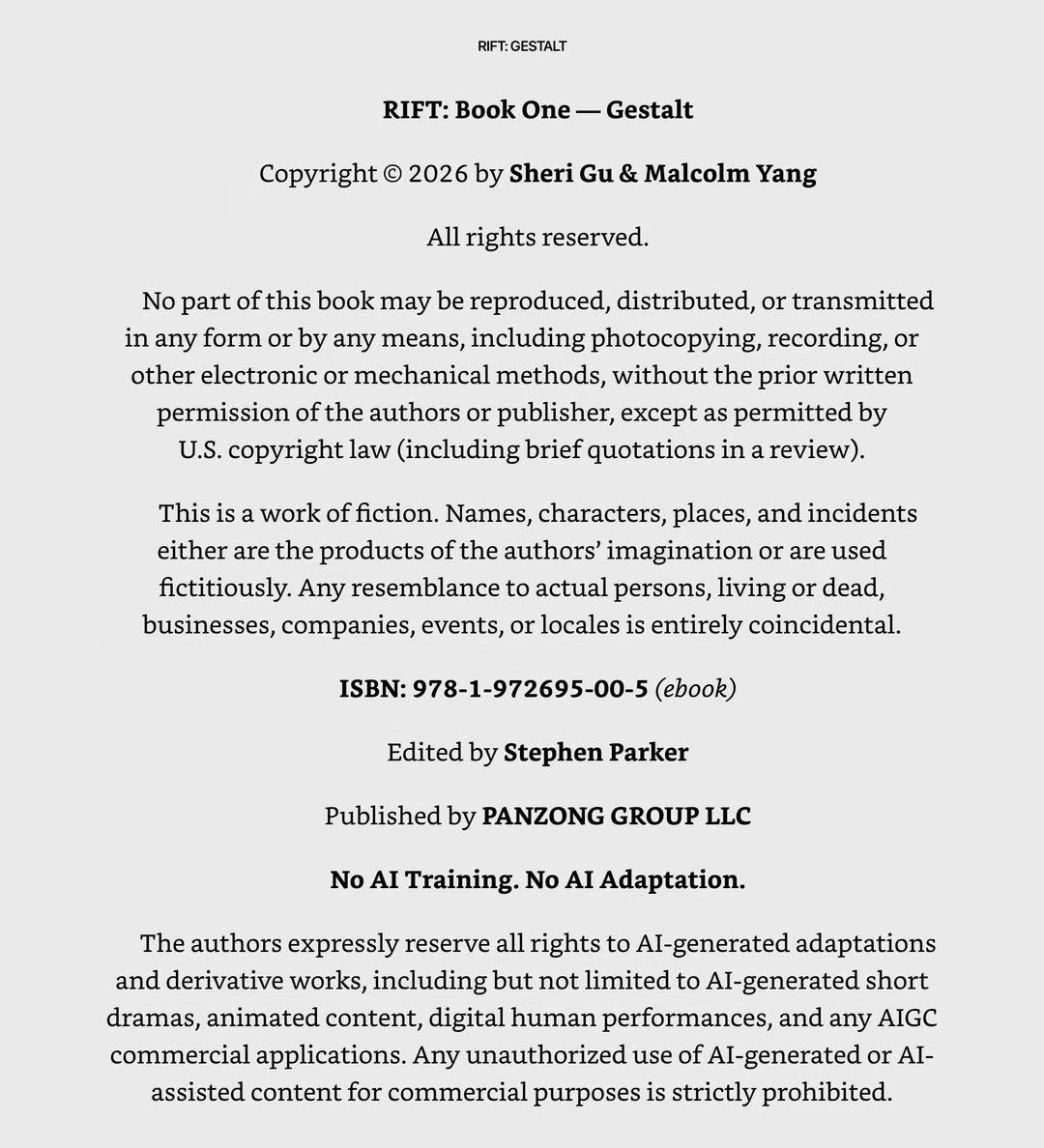
That led to a practical decision. On the copyright page of RIFT: Gestalt, I explicitly wrote “No AI Training. No AI Adaptation,” while reserving the rights to AI-generated adaptations—from short dramas and animation to digital-human performances. It was a precautionary move: if AI was going to create new ways for stories to be adapted, I wanted the right to decide how mine would be used.
A year later, that precaution looks considerably less theoretical. Chinese-born microdrama platforms have built massive audiences in the U.S., Hollywood is moving into the format, and generative AI is pushing an already low-cost model even further.
Looking past the headlines, the most consequential shift isn’t cheaper video production. It is a collapse in the cost of putting an idea in front of a real audience, measuring the signal, and deciding whether that idea deserves more capital.
That is a fundamental change in the cost of market experimentation.
A note on scope: This analysis is not an argument against traditional filmmaking or auteur storytelling. Rather, it examines the economics of experimentation—aimed at helping IP creators, entertainment executives, and investors navigate how collapsing feedback costs are reshaping risk, capital allocation, and strategic optionality.
The $60,000 Anomaly
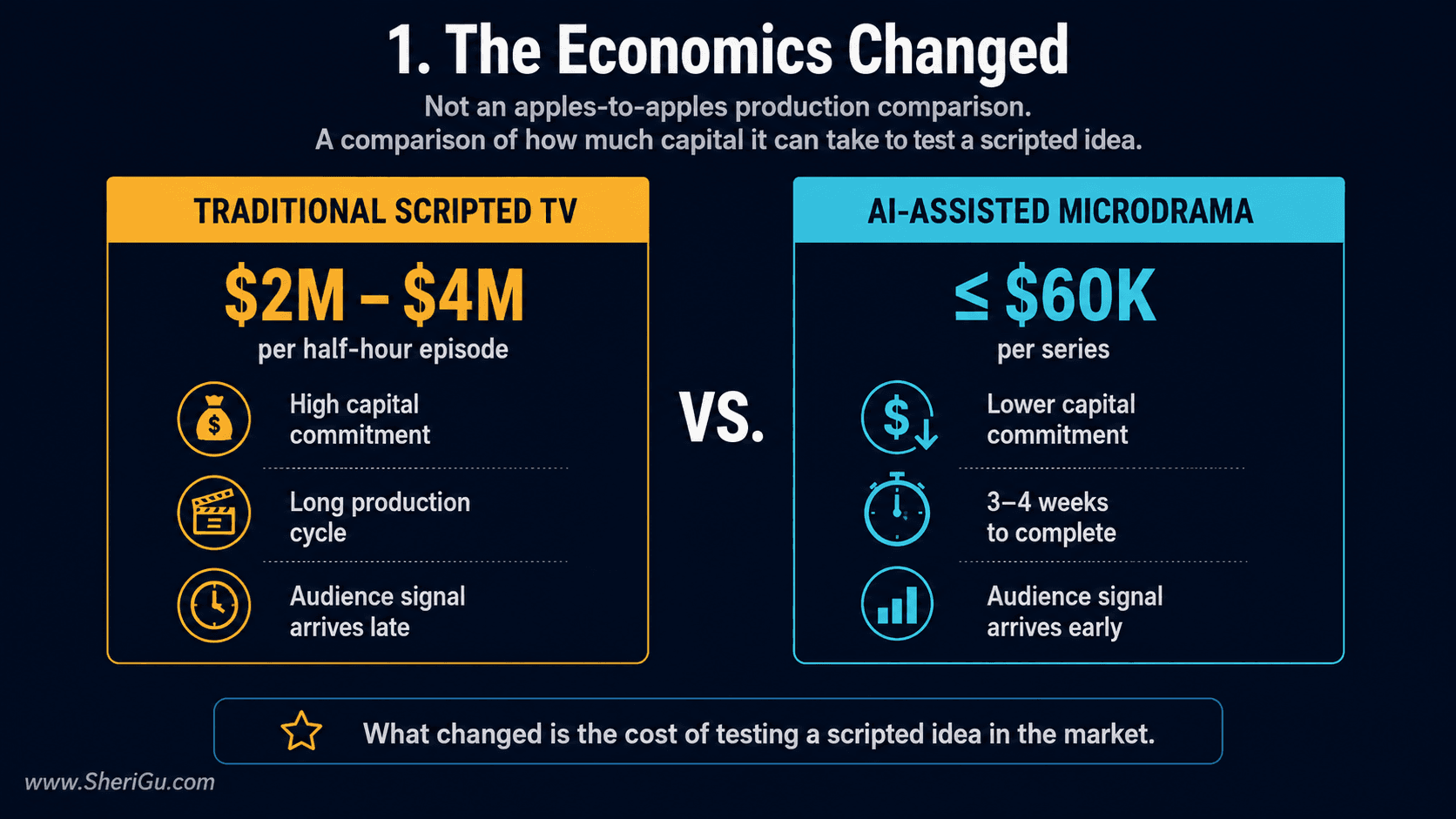
The numbers reveal the real economics. A conventional live-action microdrama typically runs 50 to 75 episodes, takes about three months to produce, and costs between $100,000 and $300,000. A typical half-hour TV episode, by contrast, costs roughly $2 million to $4 million.
The more disruptive benchmark comes from generative AI. Ironblood, an action-focused microdrama platform owned by Inkitt, uses a hybrid model with human-written scripts, human directors, and AI-assisted production workflows. According to the company, an entire series can now be completed in three to four weeks for $60,000 or less.
The workflow compression matters as much as the price. In one example reported by Reuters, a director-requested change to a character’s expression could be made within minutes rather than triggering the usual chain of reshoots, crew coordination, scheduling, and post-production.
This is not an apples-to-apples production comparison—a 60-second vertical episode is not a prestige drama. The real shift is the scale of capital required to put a scripted idea into the market and measure audience response.
A $3 million decision demands conviction. A $60,000 decision behaves more like an experiment.
What happens to an industry when finding out whether an idea works becomes dramatically cheaper?
From Production Cost to Experimentation Cost
Production cost and experimentation cost are not the same thing. Production cost asks: How much does it cost to make the content? Experimentation cost asks: How much does it cost to put an idea in front of a real audience, observe what happens, and decide what to do next?
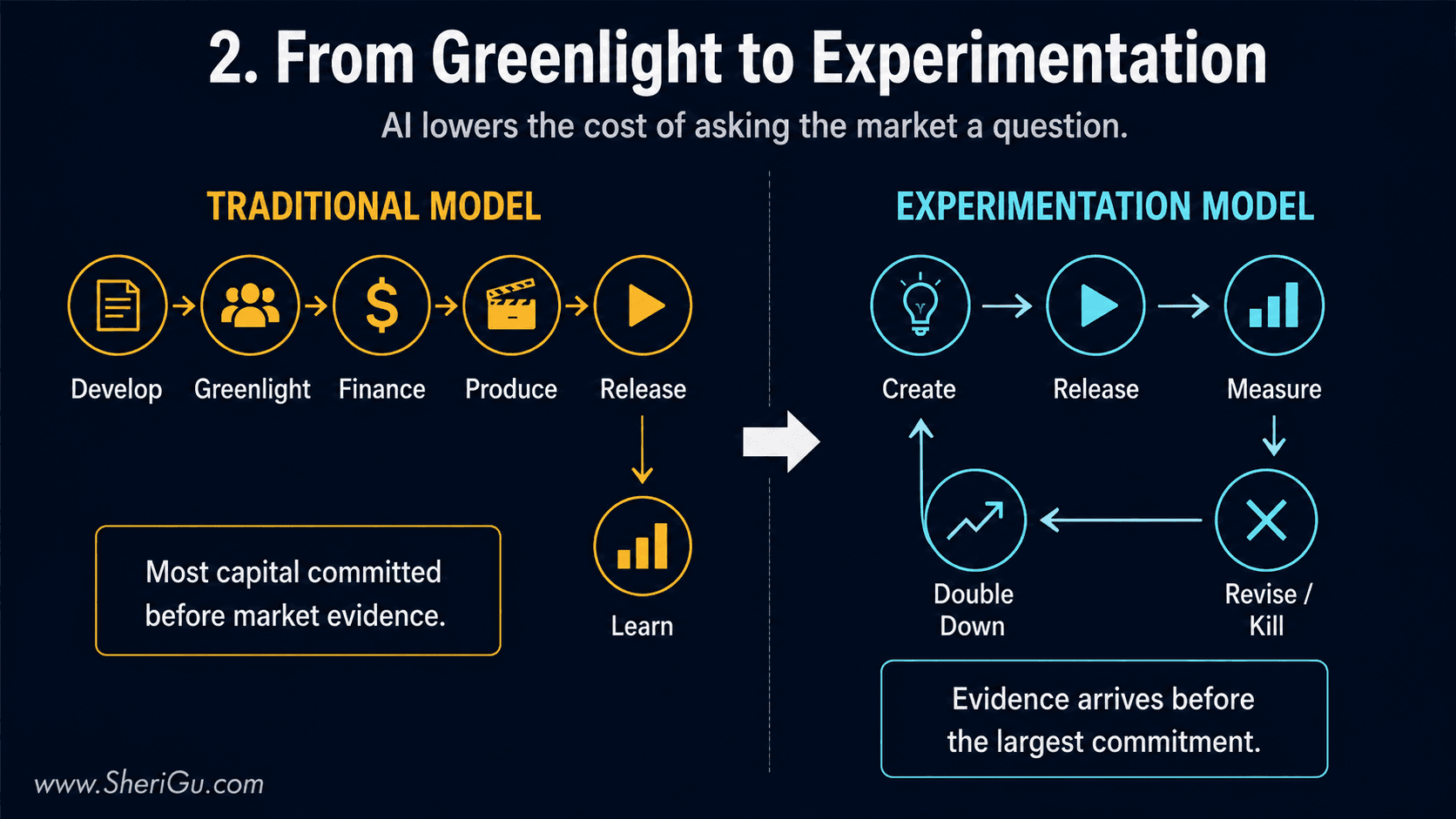
For most of Hollywood’s history, those two costs were tightly linked. Testing a scripted idea required most of the machinery of production—development, casting, crews, locations, post-production, distribution, and marketing. By the time a clear audience signal arrived, most of the capital had already been committed.
When failure is expensive, organizations rationally rely on executive judgment, historical comparables, star power, pilots, and layers of approval to reduce uncertainty before acting. But when AI compresses the cost of creating and testing an idea, the sequence begins to change: a company can pull part of market validation forward, learning before making large capital commitments.
This is why microdrama behaves less like traditional television and more like a hybrid of software, mobile gaming, and performance marketing. Its commercial architecture resembles Hook → Retention → Cliffhanger → Conversion rather than only Act I → Act II → Act III. A story beat is no longer just a narrative tool; it can also function as an acquisition trigger, a retention mechanism, or a monetization event.
Consumer behavior reflects that structure. Omdia reports that U.S. ReelShort users spend an average of roughly 35.7 minutes per day on the app—higher mobile engagement per user than Netflix, Prime Video, or Disney+ in the same market. Paired with episodic unlocks, virtual currencies, subscriptions, advertising, and paid acquisition, user behavior becomes much more legible to the platform, much earlier in the lifecycle.
The goal is no longer just to predict what might work. It is to buy information about uncertainty more cheaply.
AI does not eliminate uncertainty; it makes uncertainty cheaper to interrogate.
The Capital Allocation Shift
Once feedback becomes faster and experimentation becomes cheaper, the most important shift may not be in production at all. It may be in capital allocation.
Traditional entertainment economics rewards conviction before evidence. A project must survive development meetings, comparable analyses, talent negotiations, budget approvals, and greenlight committees long before an audience sees a single frame. Because getting to market is expensive, organizations concentrate resources behind a relatively small number of bets—and then become increasingly reluctant to abandon them once substantial capital has been committed.
Lower-cost experimentation enables a different portfolio logic. Instead of debating which three ideas deserve large budgets, a company may be able to test twenty ideas at modest cost, eliminate fifteen quickly, advance four, and concentrate serious capital behind the one that produces the strongest audience signal.
That changes the value of failure. In a high-cost system, failure is primarily a loss. In a lower-cost experimental system, a failed test can still be useful intelligence: this premise did not resonate, this character did not retain, this market did not convert, or this pricing model did not work.
This is where Test, Kill, Double Down becomes a disciplined operating model:
Test enough ideas to generate real market evidence.
Kill weak concepts before organizational commitment turns into sunk-cost defense.
Double down only when the evidence justifies a larger commitment of capital, talent, marketing, or distribution.
For executives and investors, competitive advantage may depend less on prediction alone and more on how intelligently bets are structured: learn faster, abandon weak assumptions earlier, and concentrate capital where evidence is strongest.
Cheap Creation, Expensive Attention
There is an obvious danger in taking the falling cost of production too far. Making an experiment cheaper does not make an audience cheaper. If the volume of experiments rises faster than the attention available to absorb them, the bottleneck simply moves—from producing content to getting discovered, retained, and monetized.
Microdrama already shows the limits of cheap production. A Naavik analysis using Sensor Tower data found that major apps such as ReelShort and DramaBox retain roughly 27% of U.S. users on Day 1, but fewer than 10% by Day 7. The challenge is not generating an initial click or binge; it is converting that burst of attention into durable customer value.
Media Partners Asia’s 2026 analysis of ReelShort points to the same structural constraint. Its report identifies CAC re-inflation and platform dependence as key risks. AI can compress the creation cost curve while leaving the economics of distribution and audience acquisition much less changed.
Falling experimentation costs do not eliminate scarcity. They relocate it.
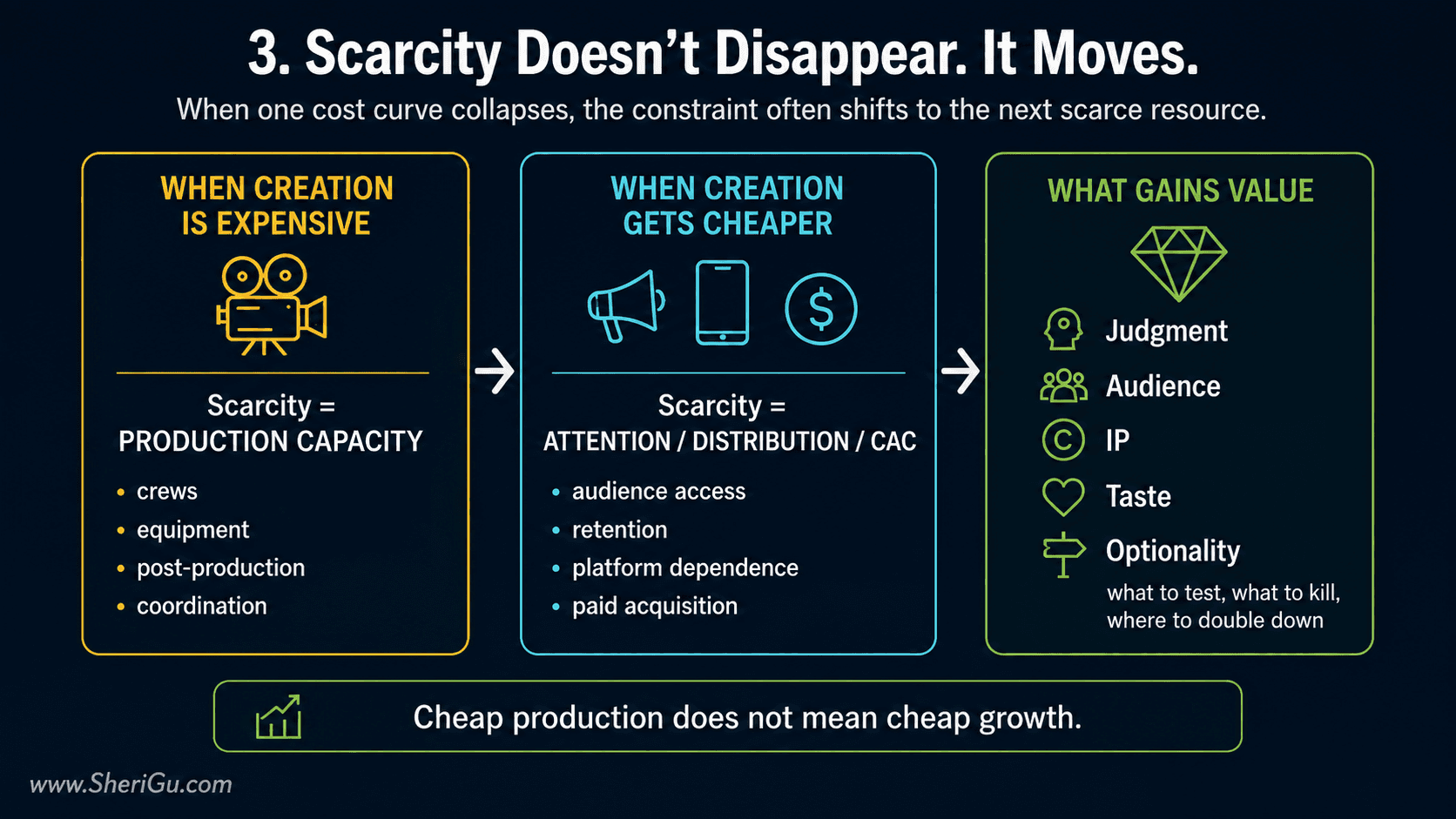
As content supply expands, what gains value?
Judgment: deciding which hypothesis is worth testing and which signal deserves follow-on capital.
Direct Audience Access: owned channels that reduce the need to repeatedly repurchase attention.
IP: recognizable worlds, characters, and concepts that support multiple experiments without rebuilding awareness from zero.
Taste: the editorial discipline to resist optimizing everything toward the statistical average.
Optionality: the ability to test, kill, adapt, or scale across emerging formats.
This also reframes the precautionary clause I placed on the copyright page of RIFT: Gestalt. At the time, reserving AI adaptation rights was simply a defensive move. Viewed through the economics of experimentation, those rights represent something more strategic: the optionality to decide later which format best serves the story—whether a conventional adaptation, an AI-assisted short-form series, interactive media, or a category that does not yet exist.
This Is Bigger Than Hollywood
Hollywood makes this shift unusually visible because the gap between a multimillion-dollar greenlight and a $60,000 experiment is so striking. But the underlying principle applies wherever AI reduces the cost of testing assumptions against reality:
In software: deploying functional prototypes to measure user behavior before making a full engineering commitment.
In marketing: testing far more concept variants and audience segments before concentrating ad spend.
In product development: exposing core hypotheses to real market friction before locking in significant capital.
Most discussions around AI productivity still focus on efficiency—completing an existing task in less time. The more consequential change may be frequency. If an organization that once tested three serious initiatives a year can now test thirty, AI has not merely accelerated the workflow. It has expanded the organization’s capacity to learn before making large, difficult-to-reverse commitments.
For decades, strategy often meant reducing uncertainty before taking action. AI changes that equation. It does not make uncertainty disappear, nor does it replace executive judgment. What it can do is lower the price of learning.
The next competitive advantage may not be being right more often. It may be being wrong more cheaply.
If AI allows you to test ten ideas for the cost of seriously funding one, should your organization still make decisions the same way?
Sources & Further Reading
1. Sheri Gu & Malcolm Yang, RIFT: Gestalt (2026). Available on Amazon
2. Zhang Rui, “China’s first AI-generated sci-fi series draws millions of viewers,” China.org.cn, May 14, 2025. Contemporaneous reporting on The Sun That Fell, a 30-episode AI-generated Chinese sci-fi microdrama completed in three months, and on the emerging use of AIGC in short-form adaptation. Read the source
3. Omdia, “Microdramas overtake streamers on mobile engagement,” February 23, 2026. Omdia’s analysis of U.S. mobile engagement, including ReelShort’s 35.7 minutes per user per day and the expansion of the international microdrama market. Read the source
4. Dawn Chmielewski, Rollo Ross, Harshita Mary Varghese & Lisa Richwine, “Microdramas boom in a shrinking Hollywood as studios chase a TikTok audience,” Reuters, August 18, 2026. Reporting on Hollywood’s entry into vertical drama, conventional microdrama production economics, Ironblood’s AI-assisted production model, and the Screen Time audience example. Read the source
5. Harshal Karvande, “The Microdrama Volume vs. Value Paradox,” Naavik, June 14, 2026. Analysis of the microdrama monetization model and Sensor Tower retention data, including roughly 27% D1 retention and sub-10% D7 retention for major U.S. apps. Read the source
6. Media Partners Asia, ReelShort / Crazy Maple Studio: Inside the US$1B Micro-Drama Machine, August 2026. Independent analysis of ReelShort’s IP funnel, data-driven greenlights, user-acquisition engine, and monetization model, including CAC re-inflation and platform dependence as key risks. View the report